A RAP Power System Blueprint Deep Dive
Aligning business models with public interest: Rethinking revenue regulation for network companies
Zsuzsanna Pató
Introduction: The tension
Inadequate power grids are a major barrier for the energy transition. Ensuring that the surge in grid demand is met and grid services remain affordable for customers is a key regulatory challenge. New grids infrastructure will be needed to replace ageing assets to connect greenfield renewable projects and to support wider system electrification. Improvements in grid use can reduce the required magnitude of grid buildout. A range of techniques may be employed to achieve this, including digitalisation and altered demand behaviours.
If electricity tariffs rise significantly to cover the avoidable costs of new grid development, it may discourage the adoption of electrification technologies and risk eroding public support for the energy transition as a result of higher living costshigher living costs At the same time rapid electrification mitigate the tariff increase by spreading the cost over more kWhs.. We need to develop incentives for network companies to control grid costs while delivering grids in line with policy goal timelines. As we must develop grids faster and at a larger scale than before, the financial stakes of arriving at the right capacity at the right locations are huge. The goal is not to arbitrarily install a fixed capacity of new grid infrastructure but to meet demand — both current and future. Improving the utilization of the existing grid, then building new infrastructure to cover any remaining gaps in capacity, will achieve this. This approach is dictated by the Energy Efficiency Directive as a fundamental principle of EU energy policy.
Table of Contents
Relevant Factsheets:
Case studies:
All regulation is incentive regulation
Grid companies are natural monopolies that do not compete on the market in providing their services. It is the role of the National Regulatory Authority (NRA) to mimic competition and steer these companies to serve their customers efficiently. Initially, grid development focused on building infrastructure from scratch and investment was supported by cost-plus regulation. Grid companies had a strong incentive to build as they earned a pre-defined profit margin on each unit of investment. The need to safeguard consumers from rising network costs has led to the introduction of incentive-based regulation such as revenue or price caps, which aimed to align operators’ incentives with cost-efficiency.
Today there is a mismatch between the default regulation, focusing on cost containment and new policy goals of decarbonisation and affordability. Policymaker and regulators increasingly recognize the need to create greater alignment between business models and the public interest.
NRAs, however, are inherently averse to the risk of incentive reform needed to match the rapidly changing realities of a decarbonising electricity system. The regulatory incentives in turn disincentivise grid companies from making use of the various technological options commercially available now to operate grids. Adding climate goals to their mandate would increase their power and willingness to innovate in regulation at pace and scale, including the incentives for grid companies. RAP identified the net zero mandate as a key empowerment tool for NRAs in work commissioned by DG Energy in 2022. Ofgem’s net zero duty added in 2023 gives Ofgem a specific net zero mandate to protect existing and future consumers’ interests and support the Government meet its legal obligation to get to net zero by 2050.
What are the flaws of prevailing regulatory mainstream in Europe?
Even though the electricity network regulations are very diverse in Europe, the majority of revenue regulation models include elements that create stronger incentives for investments in new grid capacities (CAPEXCAPEX Capital expenditures are investments into long-term physical assets to acquire, upgrade, or maintain them.) than alternative solutions to improve the use existing grids.
As a consequence, these companies:
- are averse to innovation (for example a new technology or management solution) that is superior to existing practices and/or cheaper as natural monopolies do not have the market pressure to innovate;
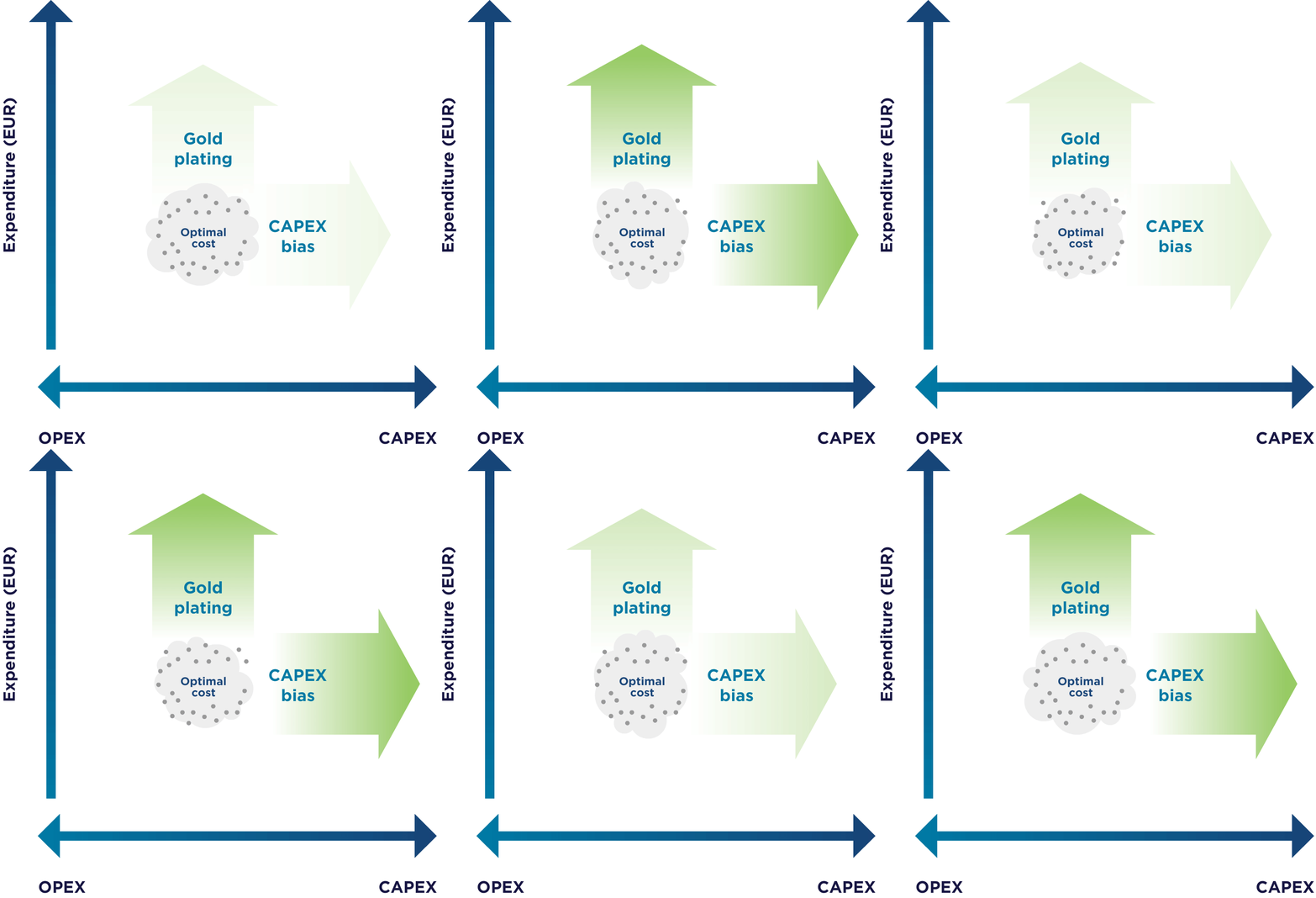
- increase their asset base (CAPEX) even if it is not need to meet consumer needs (‘gold plating’); and
- favor CAPEX over OPEXOPEX Operating expenditures are an ongoing, recurring cost., rather than seeking a balance that drives climate policy goals, because CAPEX offers long-term earnings and OPEX does not. This so-called ‘CAPEX bias’ results in fewer non-wires solutions, which tend to be OPEX-heavy.
Figure 1: Gold plating and CAPEX-bias
What are the ‘non-wire solutionsnon-wire solutions Any action, strategy, program, or technology intended to defer or remove the need to construct or upgrade physical components of a distribution and/or transmission system, or “wires investment”.?’
In the United States from where the term originates, non-wires solutions typically refer to customer-side solutions (energy efficiency, distributed generation, demand response) instead of larger transformers at substations or larger conductors. In Europe and in this paper, these are alternatives for wire-solutions, such as new substations, poles and cables. Non-wire solutions include many technology and business solutions that can either expand the available grid capacity by better operations and/or align grid use with availability. These solutions usually require cloud-computing, real-time monitoring and extensive data management (often by a third-party). They may require some new assets as well but are OPEX-heavy in general. It is often referred to as ‘digitalisation’ or ‘smarting of grids.’
How to realign regulation?
If the social goals are clearly defined, shouldn’t NRAs simply instruct network companies on what to deliver and how to achieve that? Should NRAs simply define how much a new grid is to be built, where, and in what priority order? Can an NRA pinpoint where and how the utilisation of existing grids can be improved?
Even though NRAs decide whether to underwrite the grid operation and construction costs submitted by companies, they have very limited information for making informed decisions. This information asymmetry can be mitigated, but not fully eliminated. Ultimately the network companies will always know best how to keep their systems running smoothly, knowing which opportunities and innovations are available for meeting demand for grid services. Encouraging innovation through awards and funds is only appropriate for early-stage advancements; widespread implementation of commercially available technologies and solutions need to be an inherent feature of the business model of network companies.
The creation of an independent system operator (ISO) — preferably at regional or European level — would eliminate the mentioned problems and improve the efficiency of both system operation and planning. In addition, it would facilitate better coordination with fossil gas/hydrogen network planning.
Reforming current network company regulation would include transparency requirements and financial incentives.
Transparency requirements
Financial incentives
While national regulations in Europe vary, most still favour investment in grid capacity over alternatives that could improve utilisation, which are consequently under prioritised by network companies. Network company revenue regulations are complex and the incentives they deliver are the result of various interdependent elements. Providing a blueprint regulation is difficult against such a diverse baseline regime. We try to illustrate the desired direction of reform from the vantage of a typical hybrid regulation of today that consists of:
- rate-of-return methodology on CAPEX;
- efficiency requirement on controllable OPEX; and
- performance incentive (most often it is only on quality of service).
Reducing the CAPEX-bias and gold-plating, for example by using a TOTEX approach, together with a stronger performance incentive, are the key elements of reforming the renumeration scheme of network companies.
Figure 2. Reforming the inventives of network companies


Source: RAP graphic.
There is no silver bullet solution to mitigate the CAPEX bias. The higher the allowed rate-of-return, the stronger the CAPEX bias. Setting the rate of return right — just high enough to trigger investment — is a real challenge for regulators. Setting it too high results in unjustified profits and amplifies both ‘gold plating’ and CAPEX bias. U.S. utilities have been shown to earn higher rates of return on equity compared to benchmarks estimating the cost of equity. The overestimation of borrowing costs in the UK has also recently been highlighted by consumer groups.
Below is a non-exhaustive list of options with example of countries that have already implemented them:
- The TOTEX approach: using a predetermined capitalization rate on TOTEX (CAPEX and OPEX combined) to divide it into ‘fast money’ and ‘slow money.’ The former functions like OPEX, whereas slow money is treated like CAPEX (earns a return for the investors). Determining the share of the two cost categories is the role of the NRA, which could be based on historical and/or forward-looking shares and/or ‘efficient’ shares defined by the NRA. (UK, Portugal and Italy)
- Capitalisation of certain OPEX: lets the grid company earn a return on certain OPEX, usually targeted to specific programs or innovations. (UK, Italy)
- Premium on the rate of return on desired but risky/innovative CAPEX to trigger innovation. (Italy)
- Shared savings mechanisms: the grid company can retain a share of the savings when it finds cheaper OPEX alternatives to specific capital projects, making the former more attractive compared to a theoretical efficient cost level as proposed by FSR in a study for ACER.
- Efficiency requirement on CAPEX (general or benchmarking): does not eliminate CAPEX bias but reduces it by placing efficiency requirement on both types of costs.
Figure 3. Performance-based regulation pyramid: from goals to metrics

Utilisation of the grid as a metric for PBR?
Improved utilisation of current grid infrastructure avoids unnecessary expansion and saves money for consumers. However, there is very little information available on utilisation. The 2018 JRC survey, that included 99 DSOs covering 82.73% of the customers connected to the European distribution grid, reported a transformer utilization rate* of between 2% and 21%, suggesting ample room for improvement in utilisation. Many grid operators already have some knowledge on the use of their networks, but not all, and these data are not in the public realm nor shared with the NRAs who could have a more robust view on how much grid is needed to be built after the fuller utilisation of current grids. Utilisation rate could be a metric to encourage grid companies to improve the use of their grids, parallel to building new grids where necessary.
Figure 4. Transformers capacity per LV customer
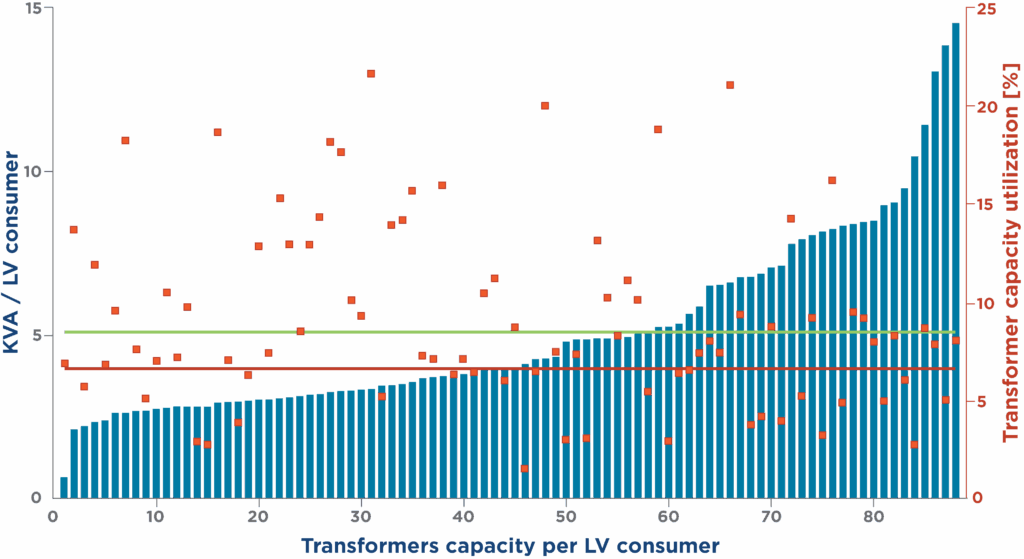
Source: JRC (2019): Distribution System Operators observatory 2018
* Distribution Transformer Utilisation. It is defined as the distributed electricity (in MWh)*100 divided by total distribution transformer capacity previously multiplied by the 8760 hours of one year.
References and further reading
- ACER. (2024, December). Electricity infrastructure development to support a competitive and sustainable energy system.
- ACER. (2023, June). Report on Investment Evaluation, Risk Assessment and Regulatory Incentives for Energy Network Projects.
- CEER. (2025, May). CEER Paper on Incentives in Regulatory Frameworks with a Focus on OPEX/CAPEX Neutrality.
- CEER. (2025, February). Report on Regulatory Frameworks for European Energy Networks 2024.
- CEER. (2018, February). Incentives schemes for regulating distribution system operators, including for innovation.
- Compass Lexecon. (2024, June). Prospects for innovative power grid technologies.
- EU DSO Entity. (2025, March). Let’s Connect – DSOs as key enablers for a competitive, green and resilient EU.
- European Commission. (2025). European Grids Package.
- European Commission. (2024, June). Regulation (EU) 2024/1747 of the European Parliament and of the Council of 13 June 2024 amending Regulations (EU) 2019/942 and (EU) 2019/943 as regards improving the Union’s electricity market design (Text with EEA relevance).
- European Commission. (2019, January). Distribution System Operators observatory 2018.
- Florence School of Regulation. (2023, June). Benefit-based incentive regulation to promote efficiency and innovation in addressing system needs.
- GEODE. (2024, June). Revenue regulation for electricity distribution system operators: A crucial enabler of the energy transition.
- Jamasb, T., Llorca, M., Meeus, L., & Schittekatte, T. (2020). Energy Network Innovation for Green Transition: Economic Issues and Regulatory Options. Copenhagen Business School.
- LeBel, M., Shipley, J., Kihm, S., Calice, M., & Cappers, P. (2023, October). Improving Utility Performance Incentives in the United States: A Policy, Legal and Financial Framework for Utility Business Model Reform. Regulatory Assistance Project.
- Manning, A. & Hughes, S. (2025, February). Debt to society: what the network companies should do with their windfall profits. Citizens Advice.
- Ofgem. (2023, 7 June). Ofgem welcomes proposed legal mandate to prioritise the UK’s 2050 net zero target [press release].
- Pató, Z., Cremona, E. & Rosslowe, C. (2024, July). Transparent grids for all — Grid(un)lock: Hosting capacity maps. Regulatory Assistance Project, Ember.
- Pató, Z. (2022, November). Options for the better integration of demand-side resources. Regulatory Assistance Project.
- Pató, Z., Baker, P. & Rosenow, J. (2019, June). Performance-based regulation: Aligning incentives with clean energy outcomes. Regulatory Assistance Project.
- Publications Office of the European Union. (2025). Investment needs of European energy infrastructure to enable a decarbonised economy.
- Romeijnders, W. & Mulder. M. (2022, March). Optimal WACC in tariff regulation under uncertainty. Journal of Regulatory Economics 61, 89–107.
- RMI. (n.d.). Performance Incentive Mechanisms (PIMs) Database.
- Werner, K.D & Jarvis, S. (2025, March). Rate of Return Regulation Revisited. Energy Institute at Haas.
The authors extend thanks to reviewers — Mareike Herrndorff, Agora Energiewende; Cara Goldenberg, RMI; Mark LeBel, Andreas Jahn, Louise Sunderland and Tim Simard, RAP. All errors are the authors’ own.
- Published:
- Last modified: March 10, 2026
 Quick guide on how to use this website: