A RAP Power System Blueprint Case Study
Italy: Step-by-step to modern revenue regulation
Zsuzsanna Pató
Italy has been working over the last two decades to finally arrive at a scheme promising to tackle the biggest problems of mainstream revenue regulation as discussed in RAP’s deep dive entitled Aligning business models with public interest: Rethinking revenue regulation for network companies.
Key messages
- Overhauling revenue regulation is challenging, but it is essential in order to keep grid costs contained. Grid companies should focus on what is valuable for consumers and provide it reliably but at the lowest possible cost.
- Key changes implemented in Italy are:
- introducing financial rewards and penalties to performance that are key for consumers;
- detaching incentives from expenditure to mitigate CAPEXCAPEX Capital expenditures are investments into long-term physical assets to acquire, upgrade, or maintain them. bias and ramp up the use of non-wire solutionsnon-wire solutions Any action, strategy, program, or technology intended to defer or remove the need to construct or upgrade physical components of a distribution and/or transmission system, or “wires investment”.; and
- moving away from a regulation based on historical costs and predefined parameters to one based on forecasts.
- Italy can provide inspiration to other countries planning future-proof revenue regulation for their grid companies in the era of rapid electrification.
This case study is part of the RAP power system blueprint deep dive Aligning business models with public interest: Rethinking revenue regulation for network companies. This particular case study examines revenue regulation in Italy since 2000.
Overview of Italian revenue regulation
Italy has been transforming the way it pays its electricity grid companies since establishing its independent regulator (ARERA) in 1997:
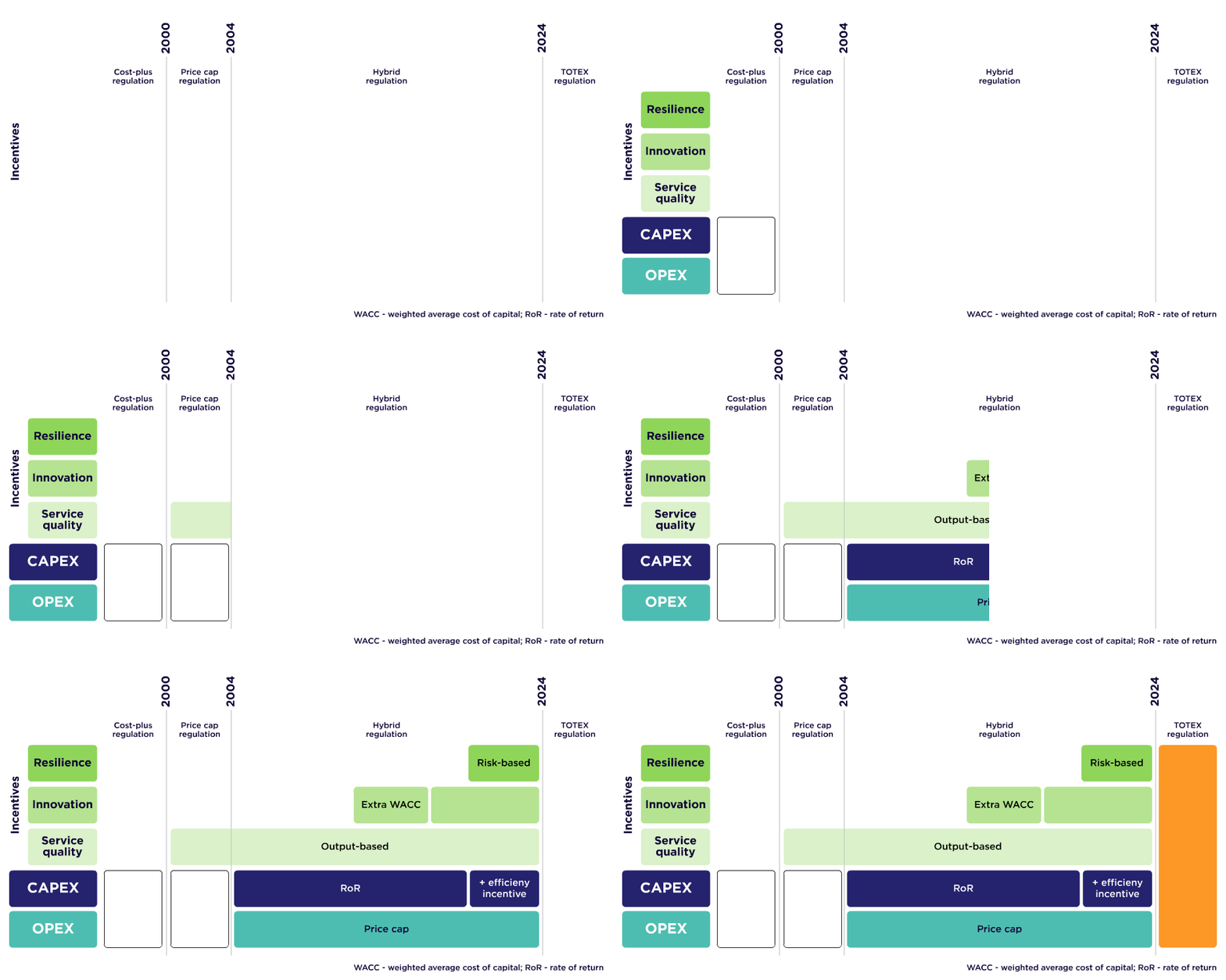
Until 2000: Cost-plus regulation that covers all incurred cost plus a reasonable profit.
2000-2004: Price cap regulation that encourages reduced costs and improved efficiency, as the grid companies can retain profits made from savings.
2004-2024: Hybrid regulation that incentivises reduced OPEXOPEX Operating expenditures are an ongoing, recurring cost. and provides a rate of return on CAPEX, with additional incentives to foster service quality, innovation and grid resilience.
2024 onwards: ROSS (Regolazione per Obiettivi di Spesa e di Servizio) consisting of ‘Basic ROSS’, a total expenditure (TOTEX) regulation, and ‘Full ROSS’, that shifts the basis of revenue-setting from historical parameters to forecasts for the biggest grid companies to pilot the scheme from 2026biggest grid companies to pilot the scheme from 2026 ARERA Resolutions 163/2023, 497/2023, and 390/2025..
Figure 1 gives on overview of the revenue regulation in Italy followed by the discussion of the incentives in the hybrid regulation and the TOTEX regulation from 2024.
Figure 1. Evolution of network company revenue regulation in Italy
Source: RAP based on Bovera, F., Schiavo, L.L. & Vailati, R. (2024). Combining Forward-Looking Expenditure Targets and Fixed OPEX-CAPEX Shares for a Future-Proof Infrastructure Regulation: the ROSS Approach in Italy. Current Sustainable Renewable Energy Reports, 11: 105–115. https://doi.org/10.1007/s40518-024-00239-4
Performance incentives under the hybrid regime
Setting performance targets directs grid companies towards goals that are important to consumers. On top of the hybrid regulation, the regulator defined various targets with financial rewards and penalties attached:
Service quality: This – the most widely pursued goal in Europe – was introduced in Italy in 2000 and has grown to cover a wide range of technical quality indicators. As a result, the quality of supply improved and converged considerably across the country with minimal impact on the tariff (EUR 2.5/consumer/year on average in the 2000-2020 period ).
Innovation: Initially, the higher risk associated with employing innovative solutions was recognised with a higher rate of return, the regulator granting an extra 2% on the weighted average cost of capital (WACC) for 12 years. It was awarded to smart grid demonstration projects in critical network areas, based on the costs and benefits of maximising the renewable energy that could be safely injected to the medium-voltage grid. Since 2015, additional risk associated with innovation has been rewarded by an output-based scheme for second-generation smart meter deploymentsecond-generation smart meter deployment Interestingly, first-generation smart meters were initially installed by Enel between 2001 and 2006 on a voluntary basis covering 85% of final consumers, without Enel being able to recover the cost in the permitted revenue/tariff. The reduction of commercial losses due to better metering and an easier disconnection process following arrears outweighed the cost of installing the relatively cheap smart meters. Only since 2007, when all DSOs were mandated to install smart metering systems, have investments been recognized in tariffs..
Since 2021, further changes to the regulatory approach allow the TSO (Terna) to keep a share of the savings achieved while meeting the goals set by the regulator. This new incentive triggered Terna to implement dynamic line rating that increased cross-zonal capacity within Italy by 1,450 MW. In return, Terna has been awarded EUR 143 million (compared to the more than EUR 1 billion of estimated savings) for the capacity increase, and for achieving it at below benchmark cost. The incentive was then extended to cover dispatch cost tooThe incentive was then extended to cover dispatch cost too ARERA Resolution 597/2021, and Terna received EUR 800 million over three years for being able to reduce dispatch cost below historical levels against an estimated baseline, with a total saving of EUR 2.2 billion.
Dynamic line rating enables better use of the existing grid than the conservative static capacity limit by taking advantage of shifting weather conditions and their effects on a power line’s thermal capacity.
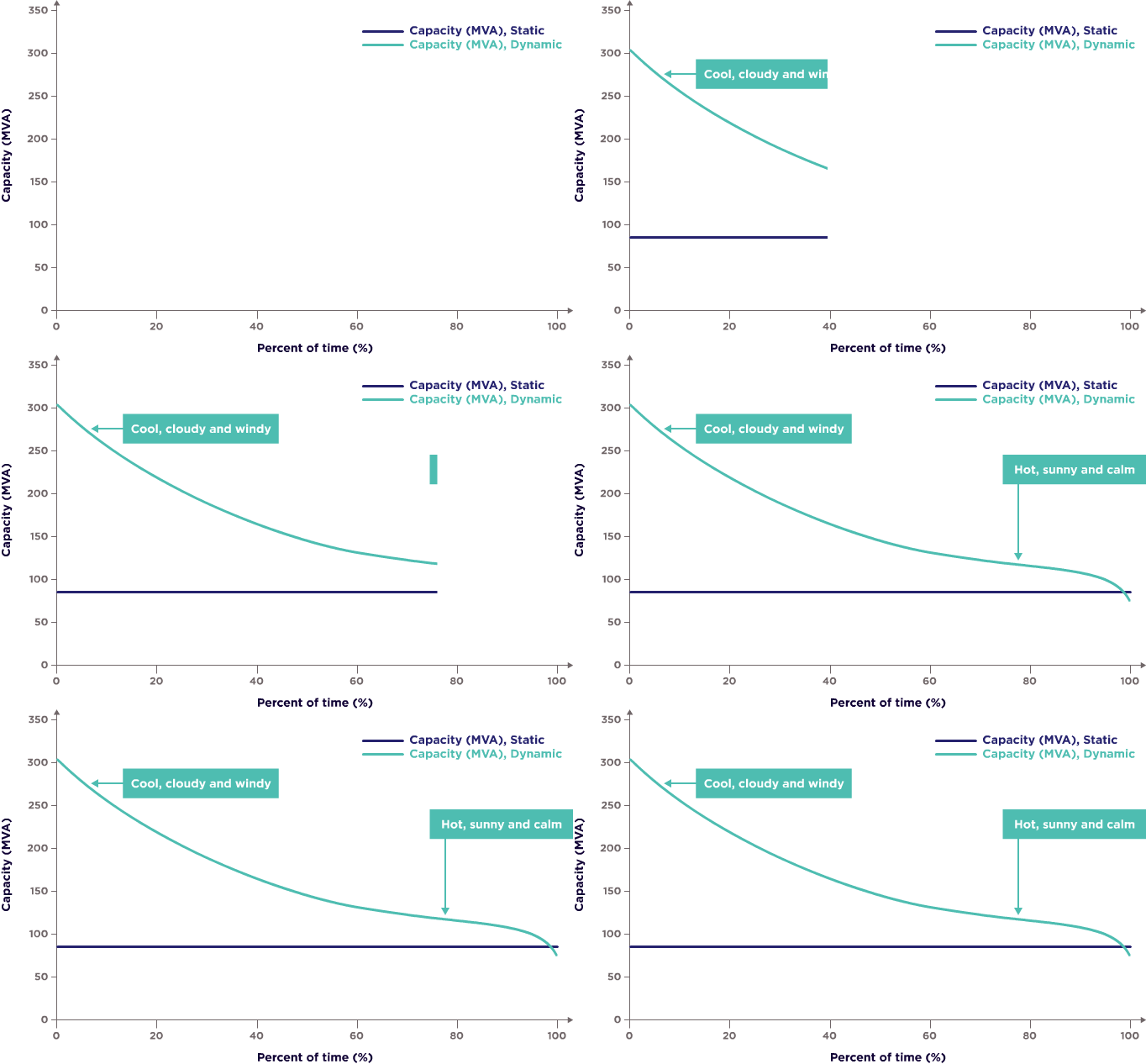
Source: IRENA. (2020). Innovation landscape brief: Dynamic line rating, International Renewable Energy Agency, Abu Dhabi
Resilience: DSOs could keep part of the net benefit for investments to improve the resiliency of their grid and had to pay a penalty if they failed to deliver the investments in time as proposed in their ‘resiliency plans.’
The ROSS regime
ROSS is being introduced in two steps. The so-called ‘Basic ROSS’ shifts the basis of remuneration onto TOTEX. It applies to the TSO (Terna) and DSOs with more than 25,000 customers. A forward-looking, sector-specific TOTEX methodology known as ‘Full ROSS’ has just been introduced as a pilot for the largest operators: Terna, e-distribuzione (the largest electricity DSO) and Snam (gas TSO).
The TOTEX logic: Basic ROSS
The allowed revenue in the Basic ROSS framework is defined in the following steps:
Step 1: The reference expenditure is set by the regulatorThe reference expenditure is set by the regulator For the first period (2024-2027) CAPEX baseline equals the actual one with no efficiency incentive set. In the next period some CAPEX items will be passed through as they are, while others – that can be linked to activity level – will be defined by standard unit costs and the volume observed ex post. The OPEX baseline is set on unit costs.. The saving – defined by the difference of the reference and the incurred TOTEX – is shared between the firm and consumersis shared between the firm and consumers Based on the choice of the company from a menu defined by the regulator, with different reference TOTEX and sharing factors. DSOs can choose at the beginning of the regulatory period between taking higher risk (higher X-factor and higher sharing factor) or lower risk (lower X-factor and lower sharing factor).. This efficiency gain is then used to adjust the actual TOTEX into allowed costs.
Step 2: Allowed costs are then allocated by the regulatorAllowed costs are then allocated by the regulator Called the fixed OPEX-CAPEX share (FOCS). The capitalisation rate is defined biannually: it is an average of the historical and forward-looking OPEX-CAPEX shares of each individual firm. into ‘slow money’ and ‘fast money’. ‘Slow money’ is treated as CAPEX, whereas ‘fast money’ is treated as OPEX – so it is not the nature of the actual expense that matters, but how the regulator defines the ‘optimal’ share of the two.
Step 3: The allowed revenue is the sum of the return on assets and depreciation linked to ‘slow money’ and the pass-through cost (‘fast money’).
Figure 2. The Basic ROSS framework

Source: RAP based on Bovera et al., 2024.
Incentives based on business plans: the Full ROSS
References
ARERA. (2023). Deliberazione 497/2023 – Criteri applicativi della regolazione per obiettivi di spesa e di servizio (ROSS) per i servizi di trasporto del gas naturale e trasmission, distribuzione e misura dell’energia elettrica (in Italian only). https://www.arera.it/filea dmin/allegati/docs/23/497-23.pdf
CEER-ECRB. (2022). 7th CEER-ECRB Benchmarking Report on the Quality of Electricity and Gas Supply, C22-EQS-103-03. https://www.ceer.eu/wp-content/uploads/2024/04/7th-Benchmarking-Report-2022.pdf
Lo Schiavo, L., Turconi, C. & Villa, F. (2019). Regulatory Incentives for Improving the Resilience of Electricity Distribution Grids in Italy, CIR33ED Conference, Madrid 6 June 2019, paper n. 2192. https://www.cired-repository.org/server/api/core/bitstreams/11baa975-40da-4508-a96c-d3af9983f994/content
Lo Schiavo, L. & Vailati, R. (2024). The Evolution of Quality and Output-Based Regulation of Electricity Networks in Italy, 2024 AEIT International Annual Conference (AEIT), Trento, Italy, 2024, pp. 01-06, doi: 10.23919/AEIT63317.2024.10736848. https://www.researchgate.net/publication/385570073_The_Evolution_of_Quality_and_Output-Based_Regulation_of_Electricity_Networks_in_Italy
The author would like to express her appreciation to the following people who provided helpful insights into drafts of this report:
Luca Lo Schiavo (ERRA from 2025, formerly ARERA), Bram Claeys and Louise Sunderland from RAP Europe.
Special thanks to Steena Williams from RAP for her review and editorial support.
- Published:
- Last modified: March 9, 2026
 Quick guide on how to use this website: