A RAP Power System Blueprint Deep Dive
Cost recovery in the electricity sector – principles and practices
Dominic Scott, Monika Morawiecka, Fjolla Fazliu & Sam Thomas
Introduction and key messages
Cost recovery methods in the electricity sector can be redesigned to support affordability, competitiveness and electrification.
Electricity prices underpin European industrial competitiveness, affordability for households and businesses, incentives to take up heat pumps, electric vehicles (EVs) and industrial electrification, and thus decarbonisation of the economy. Reducing total electricity system costs is vital to keep electricity prices in check, through faster renewables deployment, unlocking flexibility (like storage and demand response), and enhancing energy efficiency. To this end, Member States have introduced various policy instruments, all of which have a cost. This deep dive explores how design of cost recovery mechanisms can help to lower electricity costs. It examines cost recovery across Europe for a selection of strategic policies – capacity remuneration mechanismscapacity remuneration mechanisms A regulatory scheme under which payments are made to generators, load and storage (and often interconnectors) to provide capacity availability during a specific time period (to top up revenues earned in energy markets) with the aim of ensuring resource adequacy. Costs are usually recovered from customer bills via retail suppliers., non-fossil fuel support schemes, renewables support schemes and energy efficiency schemes – and outlines key principles to guide best practice. We suggest:
- The costs of capacity remuneration mechanisms (CRMs) and non-fossil flexibility support schemes* (NFFSSs) should be recovered from consumers by targeting a small number of peak hours to support efficient behaviours and keep the cost of these schemes down. These reforms should be accompanied by measures to protect vulnerable consumers and ensure they are empowered to offer their flexibility.
*In this deep dive NFFSS refers to flexibility schemes (mostly supporting battery storage) approved under existing state aid frameworks, it does not refer to schemes that may result from national flexibility needs assessments under the EU Electricity Market Design, which are still ongoing. - The cost of legacy renewable (RES) support schemes should, where possible and subject to fiscal space, be shifted from electricity bills to state budgets. Where costs continue to be recovered through electricity bills, like two-sided CfDs, alternatives to flat kWh charges – such as charges linked to connection capacities – merit further consideration and may be superior on equity, electrification and efficiency grounds.
- The cost of energy efficiency schemes, particularly those designed to support priority low income, energy poor or vulnerable households, should be shifted from electricity bills to state budgets where possible and where taxation is progressive. Current Energy Efficiency Obligation Schemes (EEOS) in Europe cover multiple fuels as well as electricity and require energy savings to be made in an untargeted way. To support incentives for electrification these obligations could be removed from electricity utilities, lowering the costs recovered through electricity. Electricity utilities could instead be required to refocus their energy efficiency efforts on reducing electricity system costsrequired to refocus their energy efficiency efforts on reducing electricity system costs Obligations on electricity utilities to make energy efficiency improvements that reduce electricity system costs would likely be passed on at times of peak demand, given that the obligations would likely be based on historic sales or throughput at peak, and recovering costs at peak would reinforce consumer incentives to reduce peak demand., with knock-on impacts on how costs might be recovered.
Table of Contents
Relevant Factsheets:
Downloads:
Selected policies
Figure 1. Policies in scope
Capacity remuneration mechanisms (CRMs)
- CRMs boost the revenues earned by resources that are available when demand pushes against the limits of supply
- CRMs often take the form of market-wide centralised capacity auctions or targeted strategic reserves
- See RAP’s CRM deep dive for an overview of these mechanisms
Non-fossil flexibility support schemes (NFFSS)
- NFFSSs are new policy innovation intended to help bridge ‘flexibility gaps’ as traditional carbon-intensive sources of flexibility such as coal and gas are phased out
- NFFSSs focus on demand-side response and storage
- See the EU’s Electricity Market Design
Renewables (RES)
support schemes
- RES support schemes include legacy subsidies like feed-in tariffs and renewable obligation schemes. Newer subsidies focus on contracts for difference, as per EU guidelines
- This deep dive focuses on utility-scale schemes
- See RAP’s deep dive for an overview of RES support mechanisms
Energy efficiency
schemes
- Energy efficiency schemes include grants, subsidies and Energy Efficiency Obligation Schemes. They promote demand reduction and efficient electrification
- Some schemes are designed to benefit priority households such as low income or vulnerable households
- See the ENSMOV plus snapshots for details of all EU EEOS and many budget-funded programmes
Note: Several policy areas are out of scope of this report to keep the scope manageable, including support for co-generation, interconnection (such as cap-and-floor regimes where applicable), hydrogen, net metering schemes and others. We exclude policies to support grid investment on the grounds that grid cost recovery already receives much attention.
Principles
To provide a framework in which to assess and guide cost recovery methods, we propose four principles to support the aims of affordability, competitiveness and electrification.
Electrification is now recognised as a major solution when transitioning away from fossil fuels, bringing efficiency and energy security benefits, with applications in all sectors. Electricity is, however, typically over-burdened with costs of policies and taxes compared to other energy vectors like gas, which can disincentivise electrification. To incentivise electrification and reduce the price of electricity, more costs can be re-allocated to other vectors like gas or removed from electricity and covered by the state budget.
Our cost recovery principles are:
- Price efficiency: This means prices are constructed to send useful signals by time and location, stimulating behaviours – in dispatch, investment and consumption – which lower system cost when acted upon. For instance, well-formed prices at peak times can lower consumption and reduce the required build-out of generation, grid and storage.
- Cost responsibility: This evokes the ‘beneficiary pays’ approach, relevant for policies that unlock ‘positive spillovers’ such as the steep learning curves that follow the mass deployment of a nascent technology, or that deliver positive social outcomes. It also evokes a ‘polluter pays’ approach, which entails putting a price on carbon (carbon emissions bring about ‘negative spillovers’ or ‘externalities’) that is broadly similar in magnitude across energy vectors.
- Minimising economic distortion: Costs beyond those recovered through efficient prices (Principle 1) should be recovered in a way that minimises changes in consumption or production. This can mean recovering costs from demands that are not especially responsive to price. Candidates might include charges linked to connection capacities. It also means recovering costs across as broad a base as possibleacross as broad a base as possible This is important because inefficiency arising from the cost recovery instrument falls dramatically as the rate falls and taxed/levied base increases. See Newbery D., Pollitt, M., Ritz, R. & Strielkowski, W. (2018). Market design for a high-renewables European electricity system, Renewable and Sustainable Energy Reviews, 91: 695-707. https://doi.org/10.1016/j.rser.2018.04.025.
- Equity and consumer protection: This means recovering costs from those most able to pay and not overburdening households or businesses, particularly those who are not able to respond to the price signal.
There are tensions between these different principles. For instance, the cost responsibility principle may not support the equity and consumer protection principle. In addition, choices on whether to recover costs from within the energy system or through state budgets are subject to constraints of the public purse. Any cost recovery approach is likely to have both merits and drawbacks, and there may be many ways of recovering cost, depending on how these principles are prioritised.
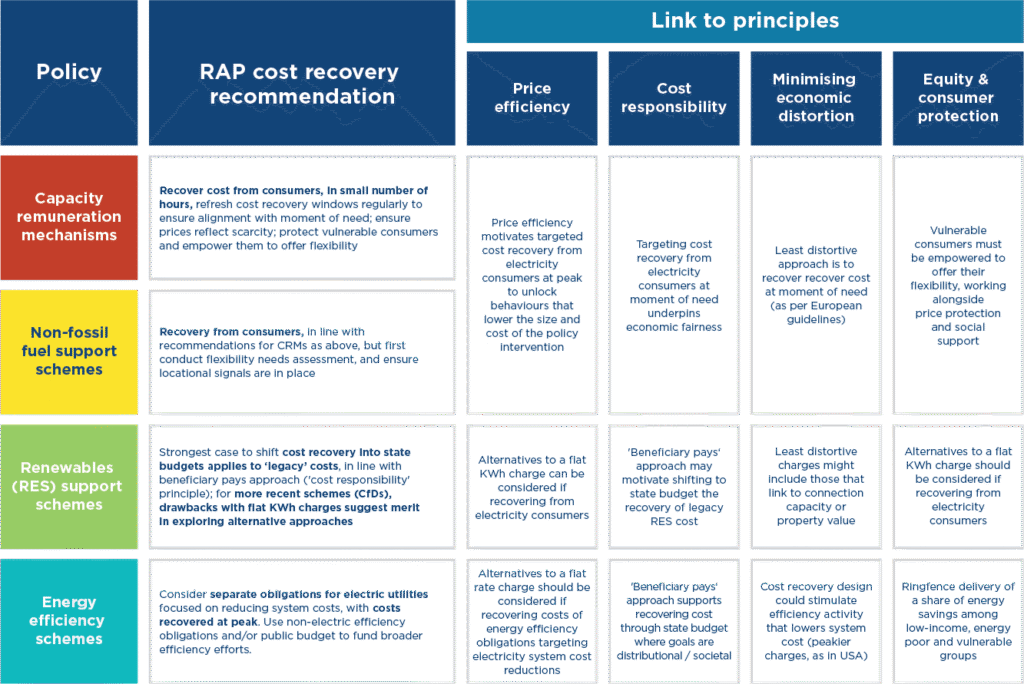
Figure 2 summarises RAP’s cost recovery recommendations with accompanying analysis against principles.
Figure 2. Policy cost recovery and link to principles
Maps of cost recovery by instrument, and application of principles
Below you can select a policy area for more information on cost recovery strategies. The maps show how costs are recovered across Europe. Data is compiled from multiple sourcesData is compiled from multiple sources These include CEER (RES Status Review 2022–2023, 2025), ACER (Security of EU Electricity Supply, 2024), EC (State Aid Decisions, 2022–2025), and Odyssee-Mure (2023), and multiple national reports – see references at end of deep dive. Wherever available, additional information from national regulatory documents and official releases was integrated. Data is therefore collected from multiple sources – and is fragmented and prone to gaps. We welcome corrections and clarifications from readers., and links predominantly to 2022, the most recent year for which data was widely available. Practices have changed in some countries in the interim. Countries are left unshaded where the policy is not in effect or where we have no data.
Click a policy
Capacity remuneration mechanisms
The stated goal of capacity remuneration mechanisms (CRMs) is to safeguard security of electricity supply by remunerating generation capacity (and storage and demand response) that is available during system stress events. They come with significant cost – for example an estimated €90 billion in capacity payments have been contracted in European capacity markets (a type of CRM) between 2014 and 2024.
All countries with CRMs currently recover costs directly from electricity consumers through levies and charges on electricity bills. The one outlier is Belgium, which recovers cost – from electricity consumers with a flat kWh charge – through an excise duty. In Belgium, cost recovery from electricity is capped, after which excise duties on heating oil are used, followed by coal and lignite if needed, with corporate taxes the last backstop.
Map A. Cost recovery practice of CRM policies across Europe
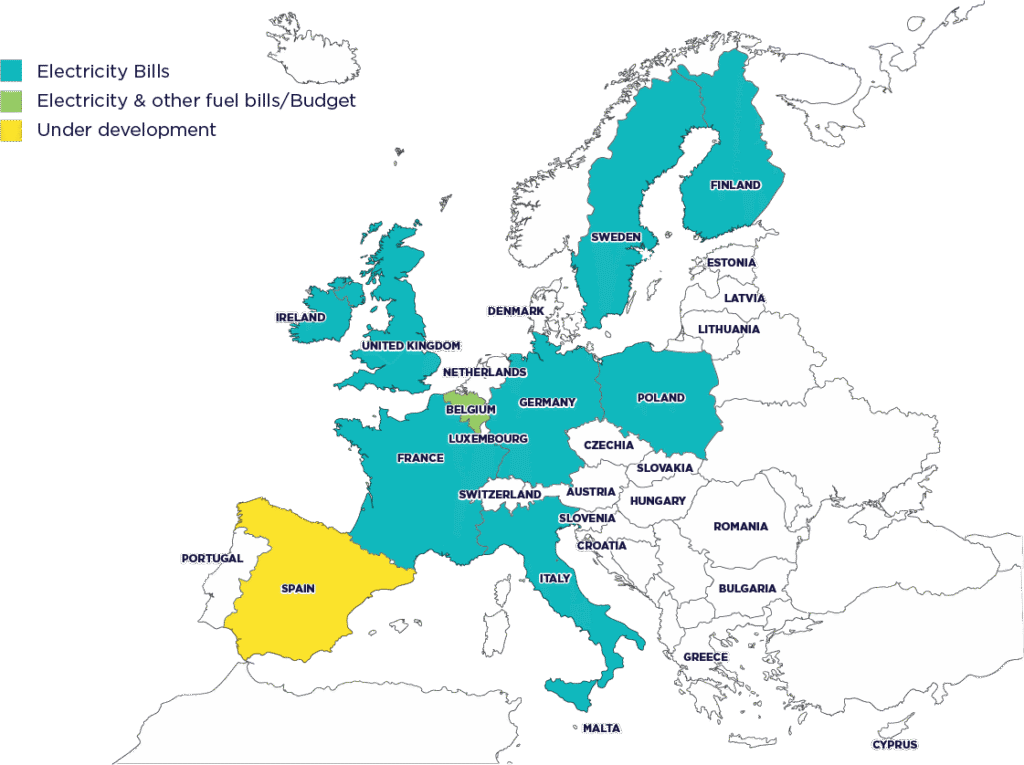
The predominant approach therefore aligns with state aid guidelines, which endorses the principle that cost should be recovered from electricity consumers.
State aid guidelines indicate that as capacity secured through the mechanism should be available in times of expected system stress, the cost of the mechanism, in principle, should be recovered from the demand that causes the stress. This aligns directly with the principle (1) of creating efficient prices – the idea is that recovering from consumers at peak times helps to motivate changes in demand patterns that can lower the size and cost of the CRM, to the benefit of consumersto the benefit of consumers These effects could be sizeable. Analysis of capacity auction offers by British regulator Ofgem showed that procuring an extra 3% of capacity can double the gross cost of a capacity auction. Similarly, recovering CRM cost during moments of use can stimulate demand response, reduce the CRM requirement and unlock sizeable savings. Ofgem. (2017). State of the energy market, 2017 report. https://www.ofgem.gov.uk/sites/default/files/docs/2017/10/state_of_the_market_report_2017_web_1.pdf. The 2025 Clean Industrial Deal State Aid Framework (CISAF) includes in its target model eligibility requirements that “at least 90% of the capacity mechanism costs must be allocated to consumers based on their consumption during at least 1% and at most 5% of the highest price hours of each year”. The link to prices here reflects an underlying assumption that price formation has been designed to reflect system stress as reserves become scarce.
Figure 3 below shows the portion of hours in the year across which costs are recovered for selected CRM cost recovery instruments. Belgian and German cost recovery instruments do not attempt to target particular hours and thus do not comply with state aid guidelines. Others like France (the Tempo tariff), Great Britain and Italy recover cost in a much smaller subset of hours. None however meet the most ambitious bounds of the CISAF target model.
Figure 3. Portion of yearly hours included in CRM cost recovery instrument

Notes: The fee for French consumers varies depending on whether they are household or non-household users. Non-household users paying a flat fee face a charge that is 41% higher than that of households on a flat fee. However, when they select a time-differentiated tariff (targeting peaks), they pay 26% less for consumption during peaks than household consumers. Clear information on charging methods and amounts is often not available to Irish, French, Finnish and Swedish household consumers. Great Britain is not subject to CISAF bounds.
Source: ACER. (2024). Security of EU electricity supply 2024 Monitoring Report. https://www.acer.europa.eu/sites/default/files/documents/Publications/Security_of_EU_electricity_supply_2024.pdf and other sources.
The Italian approach is worth mentioning. Its peak charge, over 37 times higher than its off-peak charge (not shown), applies to consumption during the 500 hours in a year projected at year ahead to have the lowest surplus of supply over demand, when prices should be highest. This approach helps ensure some alignment of the CRM cost with the demand that causes the stress. The Italian peak charge can be contrasted with other jurisdictions which allocate the costs to windows of time that are less dynamic. For example, since its introduction in 2017, the British capacity market has scheduled (i.e. not dynamic) fixed cost recovery windows for winter weekdays from 4 p.m. to 7 p.m. Our assessment of the period from 2017 to autumn 2025 shows that these windows missed nearly two-thirds (255 half hour periods) of the instances of relatively major stress. Furthermore, while this approach ‘hit’ 141 half-hours of stress, this was only achieved whilst also recovering cost over a further 4,239 half-hours where stress was not apparent. Finally, while the ‘hit’ average was 63% for 2017-2019, by 2023-2025 the average had fallen to 25%. This points to the importance of regular review of ex ante signals as the energy system changes.
The approach proposed in state aid guidelines target model eligibility requirements aligns well with the first three of our principles. It seeks to support efficient price formation and behavioural responses (Principle 1). In so doing, it also recovers costs from consumers driving the need for and benefiting from the instrument (Principle 2) and minimises economic distortions (Principle 3). Overall it can support electrification if it unlocks demand response that can contain CRM costs. However, if costs are passed in this way to household consumers, this approach creates significant challenges for equity and consumer protection (Principle 4). To mitigate this will require strategies to buffer priority groups from the price and to ensure socially inclusive demand-side flexibility.
In summary, the CRM cost in Europe is largely recovered from electricity consumers, which is broadly in line with the efficient price principle. Nevertheless, costs should generally be recovered through a more targeted portion of yearly hours. Charges that coincide with the moment of need are better than fix-and-forget approaches, and ex ante signals should be reviewed regularly as the energy system changes. All this could help unlock demand-side flexibility, limit unnecessary spend on capacity – generation and network build – and keep system costs down.
Non-fossil flexibility support schemes
The 2024 Electricity Market Design reform established a requirement for Member States to undertake a flexibility needs assessment to determine indicative objectives for the development of non-fossil flexible resources. Member States can implement flexibility support schemes for non-fossil resources if these are available and if expected resources are insufficient to meet future flexibility needs.
Outlined in the box are multiple existing national schemes that could be defined as targeting non-fossil flexibility.
Non-fossil flexibility support schemes:
- In Greece, Spain, Italy, Hungary, Poland and Slovakia schemes targeting centralised storage have been or are being introduced to deliver flexibility at the whole-system level.
- In Czechia, the scheme targets deployment of decentralised storage but with the goal of facilitating integration of renewables.
- In France the scheme supports demand-side response and storage primarily to ensure resource adequacy.
- In Lithuania, the goal of the scheme supporting centralised storage is to safeguard the secure operation of the power system under emergency island operations.
- In Ireland the scheme targets congestioncongestion Whenever a particular element on the transmission or distribution network reaches its limit and cannot carry any more electricity. Also a situation where trade between two bidding zones cannot be fully accommodated because it would significantly affect the physical flows on network elements that cannot accommodate those flows. at the distribution network level.
The Clean Industrial Deal State Aid Framework (CISAF – Section 43, paragraph 109) presents guidelines for cost recovery of non-fossil fuel support schemes (NFFSS). These state that consumers who contribute to creating the flexibility need should also contribute to the costs of meeting it, during the highest-priced hours or moments of flexibility need. This should be based on their consumption during at least 1% and at most 5% of the highest-priced hours (or market time units) each year – or, as an alternative, during at least 1% and at most 20% of the hours (or market time units) each year when the need for flexibility is more likely.
As with CRMs, the CISAF approach for NFFSSs broadly aligns with the first three of our principles: it seeks to provide efficient price signals to stimulate behaviours that lower system cost (Principle 1); recover cost from consumers driving the need for and benefiting from the instrument (Principle 2); and minimise economic distortions (Principle 3). It can support electrification if it unlocks demand response that can keep NFFSS costs down. However, if costs are passed on this way to household consumers, this approach can create challenges for equity and consumer protection (Principle 4).
Map B. Cost recovery practice of NFFSS policies across Europe
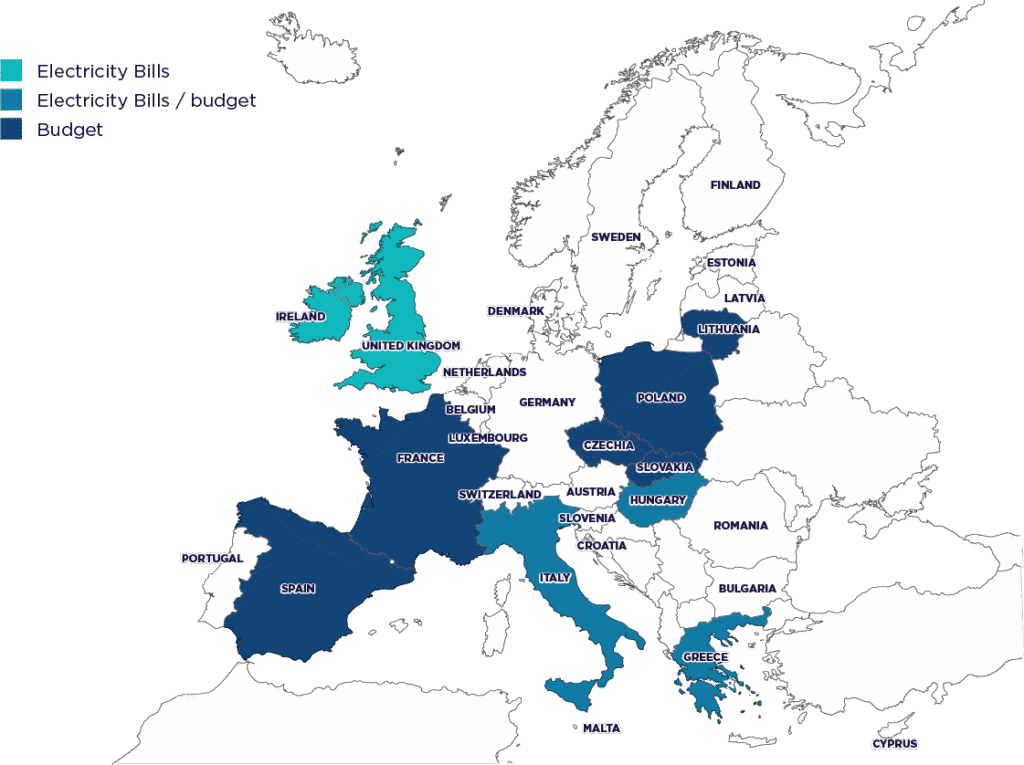
The map shows six countries that recover cost not through electricity bills but budgets (including EU funds): these are France, which collects through national state budget, Czechia*, Slovakia, Poland and Spain, which recover cost from EU funds, and Lithuania, which uses a mix of the two. Greece, Italy and Hungary supplement European funds with electricity bills. Divorcing cost recovery from electricity bills means they cannot recover during moments of need. Ireland and Great Britain are the only jurisdictions recovering cost solely through electricity bills. We have not been able to assess the percentage of hours targeted in cost recovery methods further to assess alignment with CISAF guidance.
In summary, there is a diverse array of schemes and cost recovery approaches. In principle only Ireland, Great Britain and to some extent Greece, Italy and Hungary have scope to recover cost from consumers at moments of flexibility need in line with the CISAF guidelines and our efficient price principle. More broadly across all schemes, there is a question of whether all opportunities have been exhausted to support market access for clean flexibility – like demand-side flexibility and storage – as emphasised in regulationemphasised in regulation The CISAF states that Member States must remove barriers to clean flexibility., and if there is scope to enhance the granularity in the time and location of price signals. Now that ACER has approved the flexibility assessment needs method, the first task is to perform the flexibility assessmentperform the flexibility assessment A common method for conducting these assessments was approved by ACER in July 2025. To our knowledge no assessment has yet been completed under the approved. before introducing further NFFSSs.
*Czechia recovers through the Modernisation Fund, and Spain funds through the EU Recovery and Resilience Facility (RRF) fund and the European Regional Development Fund.
Renewables support
Although renewables are becoming more cost-competitive on a stand-alone basis, a well-designed support scheme that lowers the cost of capital and accelerates deployment is likely to remain part of the policy mix for many European countries. Two-sided CfDs for cost-efficient renewables provide a natural hedge for consumers against elevated wholesale prices. At the same time many legacy support schemes, deployed during times when renewable cost was still substantial, continue to add to bills.
The map shows the costs of policies supporting utility-scale renewables are recovered through electricity bills across many European countries like Spain, Sweden, Poland and Italy. France, Finland and Latvia on the other hand recover cost through the state budget. Others, like Czechia, Greece and Belgium, recover costs through electricity bills with additional contributions from EU ETS funds (Greece) and broader state budgets (Belgium and Czechia).
Map C. Cost recovery practice of RES support policies across Europe
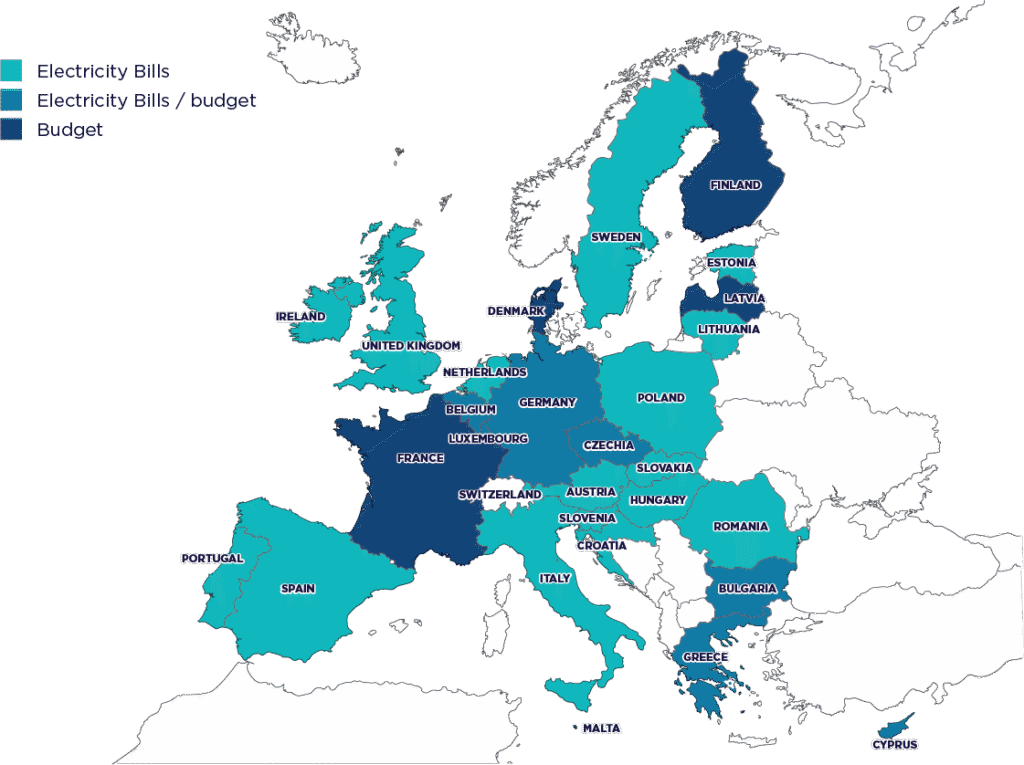
Renewables support costs typically span a wide array of mechanisms, which in many cases go back to commitments made many years ago. Although it is challenging to delineate between legacy and current support costs, there is a strong case for recovering legacy renewables costs through state budgets. This is because the rationale for supporting renewables before their breathtaking cost reductionsbefore their breathtaking cost reductions See for example capital costs versus cumulative capacity over 2010-2020 in Shrestha, H. (2022). Learning Curve Effect on the Global Variable Renewable Energy Deployment. https://medium.com/data-science/learning-curve-effect-on-the-global-variable-renewable-energy-deployment-73d1e28da390 was to contribute to the momentum of cost reduction. These investments were designed to generate the ‘positive spillover’ outlined in the cost responsibility principle (Principle 2). These subsidies therefore contributed to the development of a technology that tackles climate change, with wide societal benefits. Recovering the cost of these legacy costs through state budgets would be in line with a ‘beneficiary pays’ approach: society benefits, so society pays. This approach would support electrification.
Alignment with the equity principle (Principle 4) and with the minimising economic distortion principle (Principle 3) is harder to assess a priori as it depends on the breadth and progressiveness of the selected new cost recovery instrument(s), for example whether taxation sources are progressively structured.
Turning to more recent renewables support schemes, most of which have been implemented following the major fall in the cost of renewable generation, the case for shifting cost recovery away from electricity consumers is less strong – CfDs can be more closely considered part of the cost of (renewable) electricity generation.
A commonly used way to recover cost through bills is a flat per kWh charge. This approach, however, risks hurting vulnerable consumers most, as the flat cost per unit is likely to account for a higher portion of household income than it would for others (Principle 4: equity). It can also deter electrification, as the switch to heat pumps and EVs brings more kWhs of energy consumed. Adding a uniform volumetric surcharge to the price of each unit of electricity consumedsurcharge to the price of each unit of electricity consumed Nevertheless, if charges are to be recovered (and occasionally paid out, noting CfDs can lead to paybacks to consumers when prices are high) through a kWh charge, then it may be helpful to present these as lump-sum flows. For more information see Morawiecka, M. & Scott, D. (2023). Balancing act – Two-sided contracts for difference for a speedy, cost-efficient and equitable energy transition: A Power System Blueprint deep dive. Regulatory Assistance Project. https://www.raponline.org/knowledge-center/balancing-act-two-sided-contracts-for-difference-for-a-speedy-cost-efficient-and-equitable-energy-transition-a-power-system-blueprint-deep-dive/ is also unlikely to support efficient prices (Principle 1). Drawbacks of the flat kWh approach point to the merit of exploring alternatives like recovering costs through charges based on connection capacities.
In summary, many jurisdictions recover the entirety of their renewables support costs from electricity consumers. A principled case can be made to shift cost recovery into state budgets, particularly legacy costs, in line with a ‘beneficiary (society) pays’ approach. The case for such a shift is less pronounced for more recent support schemes like two-sided CfDs. When costs are recovered through electricity, alternatives to flat kWh charges like charges linked to connection capacities merit consideration, to explore whether they may better support electrification, efficiency and equity.
Energy efficiency
Energy efficiency policies are a broad family of instruments with diverse objectives and multiple benefits and beneficiaries. Many energy efficiency policy measures do not solely – or even primarily – target lower electricity system costs. They typically target energy savings across electricity and other fuels to unlock multiple benefits. For example, the objectives of a programme aiming to improve the energy performance of buildings might include improving the living conditions of low-income households, energy independence and carbon emissions reduction (particularly relevant for non-electric heating), as well as reducing the cost of meeting electricity needs. A specific subset of policies is Energy Efficiency Obligation schemes (EEOS), where obligated parties are required to implement measures to achieve efficiency.
The map shows cost recovery methods for energy efficiency policies across Europe. All jurisdictions analysed recover some cost through state budgets (including EU funds), while around half also use billswhile around half also use bills The introduction of emissions trading in the buildings, transport and small industry sectors (ETS 2) will see part of the EU’s allowance auction revenues dedicated to the Social Climate Fund (SCF), which participating Member States can apply for by submitting a Social Climate Plan and providing co-funding of 25% of the costs of the measures implemented. At least 60% of the SCF should be spent on green investments to increase the affordability and accessibility of emissions reductions, including energy saving renovations, decarbonisation of heating and cooling systems, and zero/low carbon vehicles. As such, many Member States’ energy efficiency measures are likely to be co-funded through fossil fuel bills (but not electricity bills) in the future. The practice of using carbon pricing revenues to fund energy efficiency measures already takes place in some Member States that have carbon taxes in place, e.g., France and Ireland.. Among those countries recovering costs through bills, all (with the exception of Italywith the exception of Italy Italy obligates electricity and gas distribution companies, with regulated cost pass-through to bill payers. All other European EEOSs obligate energy suppliers, with the costs passed through to bill payers as an additional cost of supply.) do so through the regulation of energy retailers to make final energy savings, while other programmes offering grants and subsidies tend to be funded by state budgets. Most of the EEOSs presentMost of the EEOSs present Many EEOSs allow obligated parties to buy out (a proportion of) their obligations by paying into an Energy Efficiency Fund, creating a de facto energy efficiency levy. Portugal has an explicit energy efficiency levy on electricity and gas sales, which is used to fund an energy efficiency tender mechanism (PPEC, see the ERSE website: https://www.erse.pt/en/activities/energy-efficiency/ for more detail). Switzerland has an EEOS and a levy-funded tender mechanism (Prokilowatt), both of which focus only on electricity savings. obligations across multiple energy carriers and sectors, reflecting the ‘energy carrier neutral’ and economy-wide nature of the requirements of the EU’s Energy Efficiency Directivethe EU’s Energy Efficiency Directive Article 8 EED requires Member States to make final energy savings through energy efficiency policy measures. (EED). There is little visibility on how retailers recover the cost of these schemes through bills: this is largely left to their discretion, but is likely a flat addition to per kWh rates.
Map D. Cost recovery practice of Energy Efficiency policies across Europe
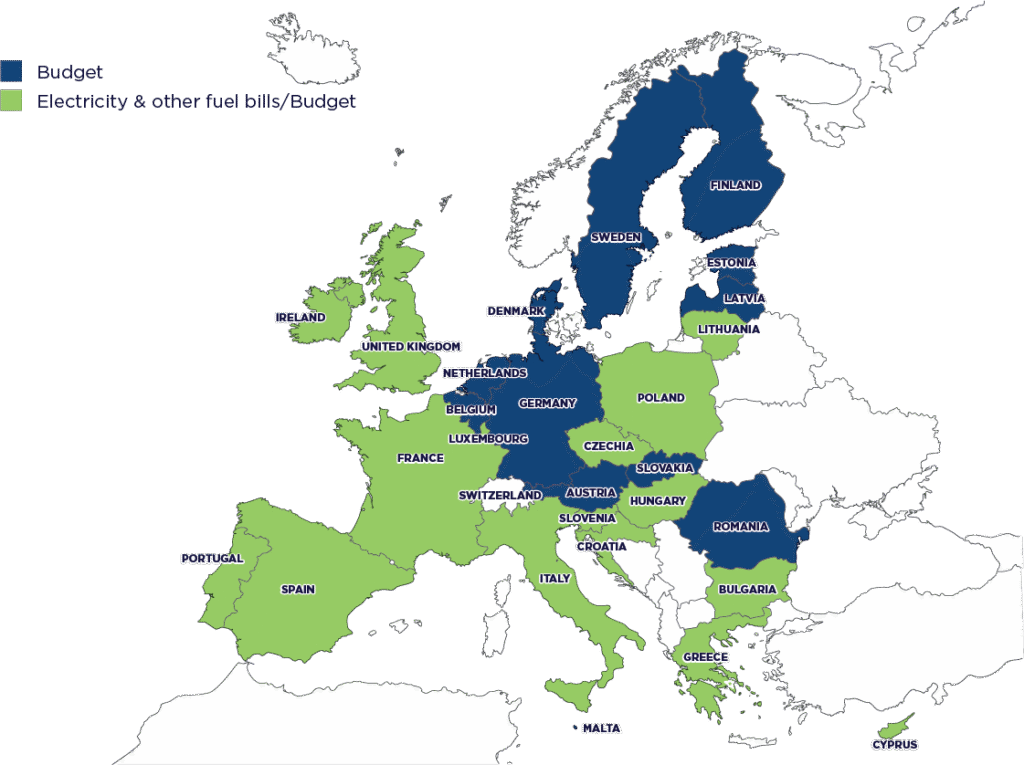
The breadth of societal objectives promoted through energy efficiency policies suggests that there is a case for bearing these costs preferentially through the state budget, particularly where there is a focus on helping vulnerable or low-income consumers (Principle 4).
As for EEOSs, which are largely recovered from consumers via retailers, the growing recognition of the need to incentivise electrification, in part through electricity system cost reduction (Principle 1), may prompt a reimagining of how EEOS cost recovery can better pursue these objectives. In a change from the ‘energy carrier neutral’ approach, obligations could be imposed and designed separately for electricity companies compared to those imposed on other energy vectors such as gas supply. For example, EEOS that focus on fuel demand reductionEEOS that focus on fuel demand reduction In some U.S. states, clean heat standards that obligate fossil fuel heat providers are being developed, with obligated parties able to choose the most cost-effective mix of fuel decarbonisation, energy demand reduction and heating system replacements to meet their clean heat targets. See Santini, M., Thomas, S., Lowes, R., Gibb, D., Cowart, R. & Rosenow, J. (2024). Clean Heat Standards Handbook. Regulatory Assistance Project. https://www.raponline.org/knowledge-center/clean-heat-standards-handbook/ and electrification (fuel switching) could be recovered from non-electricity bills, exempting electricity utilities. This would allow regulators to focus their attention on schemes that prioritise electricity system cost reduction. In addition, obligated parties could be incentivised to use cost recovery designs that support end-use energy efficiency and other demand-side actions that are effective in lowering electricity system cost. In effect, this would treat energy efficiency as an electricity system resource, in line with the EED’s ‘energy efficiency first’ principle.
In jurisdictions outside Europe that experience accentuated system cost differences between peak and off-peak, energy savings programmes are moving towards targeting energy savings at peak. For example, in the United States, some energy efficiency resource standards (‘utility obligations’) have begun to target peak electricity reductions, with advances in the understanding of the load profile of energy efficiency actions enabling a more nuanced approach aligned with lowering system cost. An obligation on retailers that results in higher costs at times of historic peak demand might motivate them to recover more cost at peak, thus incentivising a behavioural change that would reduce their obligations in future.
In conclusion, energy efficiency policy costs are currently recovered both through bills and state budgets. As most non-EEOS programme costs are already recovered through public budgets, there is limited scope to reduce cost for electricity consumers there. As the cost of EEOS programmes is recovered through electricity and other energy bills, separating electricity EEOS schemes from others would allow regulators to focus them on the objective of lowering electricity system costs. This might also motivate retailers to adopt a cost recovery approach that better supports this goal. As this could see more cost recovered at peak times, accompanying measures that enable the offer of socially inclusive demand-side flexibility will be essentialaccompanying measures that enable the offer of socially inclusive demand-side flexibility will be essential This requires prioritising in deployment of user-friendly and flexible assets those most heavily burdened by their energy bills and living in the worst-quality housing. This means providing affordable access to technologies and services that facilitate flexibility – such as high-speed internet access and smart meters and controls – and to flexibility-enabling upgrades to buildings and other infrastructure. See Yule-Bennett and Sunderland, 2024..
References and further reading
Bishop, R., & Böhmer, D. (2025, January). Capacity remuneration mechanisms in Europe (Report prepared for Beyond Fossil Fuels). Aurora Energy Research. https://beyondfossilfuels.org/wp-content/uploads/2025/01/20250123_Aurora_BFF_CRM-Report_final.pdf
European Commission. COMMUNICATION FROM THE COMMISSION Framework for State Aid measures to support the Clean Industrial Deal (Clean Industrial Deal State Aid Framework) (C/2025/3602) of 4 July 2025. Section 43, paragraph 109. https://eur-lex.europa.eu/legal-content/EN/TXT/HTML/?uri=OJ:C_202503602#:~:text=The%20Commission%20will%20consider%20aid,this%20sub%2Dsection%20are%20met.&text=investment%20to%20change%20the%20primary,subsidisation%20of%20fossil%2Dbased%20generation
Mims Frick, N. Long, A., Relf, G. Light, T. & Sandonato, A.. (2025). Reimagining Energy Efficiency Resource Standards. Lawrence Berkeley National Laboratory under Contract No. DE-AC02-05CH11231 with the U.S. Department of Energy. https://eta-publications.lbl.gov/sites/default/files/2025-01/lbnl_eers_report_v0113_final.pdf
Morawiecka, M. & Scott, D. (2023). Balancing act – Two-sided contracts for difference for a speedy, cost-efficient and equitable energy transition: A Power System Blueprint deep dive. Regulatory Assistance Project. https://www.raponline.org/knowledge-center/balancing-act-two-sided-contracts-for-difference-for-a-speedy-cost-efficient-and-equitable-energy-transition-a-power-system-blueprint-deep-dive/
Newbery D., Pollitt, M., Ritz, R. & Strielkowski, W. (2018). Market design for a high-renewables European electricity system, Renewable and Sustainable Energy Reviews, 91: 695-707. https://doi.org/10.1016/j.rser.2018.04.025
Ofgem. (2017). State of the energy market, 2017 report. https://www.ofgem.gov.uk/sites/default/files/docs/2017/10/state_of_the_market_report_2017_web_1.pdf
European Commission. (n.d.). Electricity market design. https://energy.ec.europa.eu/topics/markets-and-consumers/electricity-market-design_en
Oxenaar, S., & Butler, T. (2025, October 30). Making electricity cheaper: Modernising taxes and levies to incentivise electrification of industrial heat. Regulatory Assistance Project. https://www.raponline.org/knowledge-center/making-electricity-cheaper-incentivise-electrification-of-industrial-heat/
Santini, M., Thomas, S., Lowes, R., Gibb, D., Cowart, R. & Rosenow, J. (2024). Clean Heat Standards Handbook. Regulatory Assistance Project. https://www.raponline.org/knowledge-center/clean-heat-standards-handbook/
Shrestha, H. (2022). Learning Curve Effect on the Global Variable Renewable Energy Deployment. Medium. https://medium.com/data-science/learning-curve-effect-on-the-global-variable-renewable-energy-deployment-73d1e28da390
Sunderland, L., Gibb, D., & Thomas, S. (2025, September 29). Making electricity cheaper: Redistributing policy costs for affordable household heat electrification. Regulatory Assistance Project. https://www.raponline.org/knowledge-center/making-electricity-cheaper-affordable-household-heat-electrification/
Sunderland, L., Pató, Z., Morawiecka, M., & Claeys, B. (2025, September 29). Making electricity cheaper: RAP’s eight priority actions. pp. 1-2. Regulatory Assistance Project. https://www.raponline.org/wp-content/uploads/2025/09/rap-sunderland-pato-morawiecka-claeys-eight-priority-actions-september-2025.pdf
Yule-Bennett, S. & Sunderland, L. (2024). Flex-ability for all. Regulatory Assistance Project. https://www.raponline.org/wp-content/uploads/2023/12/rap-yule-bennett-sunderland-flex-ability-all-socially-inclusive-demand-side-flexibility-europe-2024-january.pdf
Capacity remuneration mechanisms
Belgium, International Energy Agency (IEA). Belgium 2022 – Energy Policy Review. https://iea.blob.core.windows.net/assets/638cb377-ca57-4c16-847d-ea4d96218d35/Belgium2022_EnergyPolicyReview.pdf
European Commission. State Aid Decision SA.104336 – Belgium Capacity Remuneration Mechanismcapacity remuneration mechanism A regulatory scheme under which payments are made to generators, load and storage (and often interconnectors) to provide capacity availability during a specific time period (to top up revenues earned in energy markets) with the aim of ensuring resource adequacy. Costs are usually recovered from customer bills via retail suppliers.. https://ec.europa.eu/competition/state_aid/cases1/202340/SA_104336_B04EFF8A-0000-CDF2-866E-13BF028481FA_65_1.pdf
Finland, Fingrid. Peak Load Capacity Fees 2025. https://www.fingrid.fi/en/grid/peak-load-capacity/fees/peak-load-capacity-2025/
France – Decentralised capacity market, Commission de régulation de l’énergie (CRE). Délibération TRVE – Annexe A. https://www.cre.fr/fileadmin/Documents/Deliberations/2025/250115_2025-10_TRVE_inf_36_annexe_A.pdf
France – New capacity market (underway), RTE. Se préparer au nouveau mécanisme de capacité. https://www.services-rte.com/fr/decouvrez-nos-offres-de-service/se-preparer-au-nouveau-mecanisme-de-capacit%C3%A9.html Ministry for the Ecological Transition (France). Consultation publique – mécanisme de capacité. https://www.ecologie.gouv.fr/sites/default/files/documents/Consultation%20publique%20m%C3%A9canisme%20de%20capacit%C3%A9.pdf
Germany, Federal Republic of Germany. Energy Industry Act (EnWG), §13e. https://www.gesetze-im-internet.de/enwg_2005/__13e.html European Commission. State Aid Decision SA.48648 – Germany: Capacity Reserve. https://eur-lex.europa.eu/legal-content/EN/TXT/PDF/?uri=CELEX:32018D0860
Germany – Capacity mechanism (under discussion), Federal Ministry for Economic Affairs and Climate Action (BMWK). Monitoring Report – Making the Energiewende Efficient. https://www.bundeswirtschaftsministerium.de/Redaktion/DE/Publikationen/Energie/energiewende-effizient-machen.pdf?__blob=publicationFile&v=20
Ireland, SEM Committee. Tariffs and Charges for TY 2024–25 (SEM-24-056). https://www.semcommittee.com/files/semcommittee/2024-09/SEM-24-056%20SEM%20Tariffs%20and%20Charges%20for%20TY2024-25.pdf
Italy, European Commission. State Aid Decision SA.38635 – Italy Capacity Market. https://ec.europa.eu/competition/state_aid/cases/270875/270875_1979508_218_2.pdf
Poland, President of the Energy Regulatory Office (URE). Capacity levy for 2025. https://www.ure.gov.pl/en/communication/news/403,Capacity-levy-for-2025-published-by-President-of-URE.html
Spain, Ministry for the Ecological Transition and the Demographic Challenge (MITECO). Propuesta – Mercado de Capacidad. https://www.miteco.gob.es/content/dam/miteco/es/energia/files-1/es-ES/Participacion/Documents/aeip-mecanismos-de-capacidad/Propuesta_OM_MercadodeCapacidad.pdf
Sweden, Svenska kraftnät. Det här betalar du – balanskraft och effektreserv. https://www.svk.se/aktorsportalen/balansansvarig-part/det-har-betalar-du/
Non-fossil flexibility support schemes
Czechia, European Commission. State aid decision SA.117215. https://ec.europa.eu/competition/state_aid/cases1/202513/SA_117215_55.pdf
France, European Commission. State aid decision SA.107352 (2023). https://ec.europa.eu/competition/state_aid/cases1/202405/SA_107352_70255A8D-0000-CC37-8D71-46CB470EBA1A_49_1.pdf
Great Britain, Ofgem. Long-Duration Electricity Storage. https://www.ofgem.gov.uk/energy-regulation/low-carbon/long-duration-electricity-storage
Greece, European Commission. State aid decision SA.64736 (2022). https://ec.europa.eu/competition/state_aid/cases1/202240/SA_64736_400E7A83-0000-C599-B417-2392BF680950_60_1.pdf
Hungary, European Commission. State aid decision SA.102428 (2023). https://ec.europa.eu/competition/state_aid/cases1/202330/SA_102428_F09B8D89-0100-C81D-9E22-4DB74E82A2DE_73_1.pdf
Ireland, Commission for Regulation of Utilities (CRU). Decision CRU202469 – DSO Demand Flexibility Product Procurement. https://cruie-live-96ca64acab2247eca8a850a7e54b-5b34f62.divio-media.com/documents/CRU202469_DSO_Demand_Flexibility_Product_Procurement_Decision_Paper.pdf
Italy, European Commission. State aid decision SA.104106 (2023). https://ec.europa.eu/competition/state_aid/cases1/202414/SA_104106_202FA48E-0000-CC73-8839-192E7D98527F_174_1.pdf
Lithuania, European Commission. State aid decision SA.115362 (2024). https://ec.europa.eu/competition/state_aid/cases1/202447/SA_115362_63.pdf
Poland, EU funds – European Commission. (2024). Commission approves €1.2 billion Polish State aid scheme to support investments in electricity storage facilities to foster the transition to a net-zero economy. https://ec.europa.eu/commission/presscorner/detail/en/ip_24_4985
Slovakia, European Commission. State aid decision SA.106554 (2023/N). https://ec.europa.eu/competition/state_aid/cases1/202403/SA_106554_F0E8168D-0000-CF9B-989F-10E7ABBD77C3_80_1.pdf
Spain, European Commission. State aid decision SA.103068 (2023). https://ec.europa.eu/competition/state_aid/cases1/202402/SA_103068_C06FED8C-0100-CB2A-A2A3-D0CD056F25DD_156_1.pdf European Commission. State aid decision SA.116836 (2025). https://ec.europa.eu/competition/state_aid/cases1/202521/SA_116836_39.pdf
Renewables support schemes
Belgium – additional source, Febeliec. Green Support Costs (Vlaanderen). https://www.febeliec.be/data/1744117475GSC%20Vlaanderen_ENG_20250318.pdf
Bulgaria – national legal and regulatory sources, Energy Act (Bulgaria). https://lex.bg/laws/ldoc/2135475623 Energy and Water Regulatory Commission (KEVR). Decision № Ц-25 / 01.07.2025. https://www.dker.bg/uploads/reshenia/2025/res-c-25-2025.pdf
CEER (used for multiple countries), Council of European Energy Regulators (CEER). Renewables in Europe – RES Status Review 2022–2023. https://www.ceer.eu/wp-content/uploads/2025/07/RES_status_review_2022_2023_C24-RES-84-05_final.pdf
Cyprus, Republic of Cyprus. Law on the Promotion of the Use of Energy from Renewable Sources. https://www.cylaw.org/nomoi/enop/non-ind/2003_1_33/full.html
Denmark, OECD. Denmark 2023. https://www.oecd.org/content/dam/oecd/en/publications/reports/2023/12/denmark-2023_7d3ba636/755105d6-en.pdf
Finland – additional source, National Audit Office of Finland. Feed-in Tariff as an Instrument for Subsidising Wind Power. https://www.vtv.fi/en/publications/feed-in-tariff-as-an-instrument-for-subsidising-wind-power/
Germany, Federal Government of Germany. Climate and Transformation Fund (KTF) – Special Assets. https://www.bundesregierung.de/breg-de/aktuelles/ktf-sondervermoegen-2207614
Luxembourg – additional source, Grand Duchy of Luxembourg. Règlement grand-ducal – Fonds climat et énergie. https://legilux.public.lu/eli/etat/leg/rgd/2022/12/23/a674/consolide/20240806
Netherlands, Government of the Netherlands. Energy Tax. https://business.gov.nl/regulation/energy-tax/
Romania – additional source, PPC Energy Romania. Valoare certificate verzi. https://www.ppcenergy.ro/wp-content/uploads/valoare-certificate-verzi.pdf
Sweden, Swedish Energy Agency. Elcertifikatsystemet – Elkundens bidrag till förnybar elproduktion. https://www.energimyndigheten.se/energisystem-och-analys/styrmedel-for-elproduktion/elcertifikatsystemet/om-elcertifikatsystemet/elkundens-bidrag-till-fornybar-elproduktion/
Energy efficiency schemes
Austria, Odyssee-Mure. Energy Efficiency Trends and Policies Profile: Austria. https://www.odyssee-mure.eu/publications/efficiency-trends-policies-profiles/austria.html
Belgium (Flanders), Odyssee-Mure. Direct grants for buildings renovation (Flanders). https://www.measures.odyssee-mure.eu/energy-efficiency-policies-database.html#/measures/11
Bulgaria, Odyssee-Mure. Energy Efficiency Trends and Policies Profile: Bulgaria. https://www.odyssee-mure.eu/publications/efficiency-trends-policies-profiles/bulgaria.html Odyssee-Mure. Support for sustainable energy renovation of the residential building stock. https://www.measures.odyssee-mure.eu/energy-efficiency-policies-database.html#/measures/4483
Croatia, European Commission. Croatia – Draft Updated National Energy and Climate Plan 2021–2030. https://commission.europa.eu/publications/croatia-draft-updated-necp-2021-2030_en
Cyprus, Odyssee-Mure. Electricity levy for RES and Energy Efficiency (RESEE). https://www.measures.odyssee-mure.eu/energy-efficiency-policies-database.html#/measures/3982
Czechia, Concerted Action EED. Energy Efficiency Policy Framework – Czech Republic. https://www.ca-eed.eu/ia-document/energy-efficiency-policy-framework-czech-republic/
Denmark, Concerted Action EED. National Implementation Report – Denmark. https://www.ca-eed.eu/ia-document/national-implementation-report-denmark/
Estonia, Odyssee-Mure. Energy Efficiency Trends and Policies Profile: Estonia. https://www.odyssee-mure.eu/publications/efficiency-trends-policies-profiles/estonia.html
Finland, 4i-TRACTION. Finnish Voluntary Energy Efficiency Agreements – Case Study. https://www.4i-traction.eu/sites/default/files/2023-04/4iT_2023_Case_Study_2_Finnish_Voluntary_EEAs.pdf
France, Odyssee-Mure. Energy Saving Certificates (CEE). https://www.measures.odyssee-mure.eu/energy-efficiency-policies-database.html
Germany, BMWK. Evaluation of the Federal Funding for Efficient Buildings (BEG), 2023 – Short Version. https://www.energiewechsel.de/KAENEF/Redaktion/DE/PDF-Anlagen/BEG/beg-evaluation-2023-kurzfassung-englisch.pdf?__blob=publicationFile&v=2
Greece, Odyssee-Mure. Energy Efficiency Obligation Scheme (EEOS) – Greece. https://www.measures.odyssee-mure.eu/energy-efficiency-policies-database.html#/measures/5001 International Energy Agency (IEA). Greece 2023 – Energy Policy Review. https://iea.blob.core.windows.net/assets/5dc74a29-c4cb-4cde-97e0-9e218c58c6fd/Greece2023.pdf
Hungary, Odyssee-Mure. Energy Efficiency Trends and Policies Profile: Hungary. https://www.odyssee-mure.eu/publications/efficiency-trends-policies-profiles/hungary.html
Ireland, SEAI. Energy Efficiency Obligation Scheme (EEOS). https://www.seai.ie/about/regulatory-functions/energy-efficiency-obligation-scheme/about-eeos SEAI. Home Energy Grants. https://www.seai.ie/grants/home-energy-grants
Italy, IEECP. Overview of the Italian White Certificates Scheme. https://ieecp.org/wp-content/uploads/2025/04/01_Intro_ItalianScheme_DiSanto_20250401.pdf SocialWatt. Policy Fact Sheets – Energy Efficiency and Energy Poverty. https://socialwatt.eu/sites/default/files/socialwatt_tools/D4.6%20Policy%20fact%20sheets_final.pdf
Latvia, Odyssee-Mure. Energy Efficiency Trends and Policies Profile: Latvia. https://www.odyssee-mure.eu/publications/efficiency-trends-policies-profiles/latvia.html
Lithuania, EnergySavingPolicies.eu. Energy Saving Agreements in Lithuania. https://energysavingpolicies.eu/wp-content/uploads/2024/03/1-2_Energy-Saving-Agreements-in-Lithuania-2024_MMizutavicius.pptx
Luxembourg, Odyssee-Mure. Energy Efficiency Obligation Scheme – Luxembourg. https://www.measures.odyssee-mure.eu/energy-efficiency-policies-database.html#/measures/4455
Netherlands, EnergySavingPolicies.eu. The Netherlands – Package for Buildings. https://energysavingpolicies.eu/wp-content/uploads/2024/03/1-3_Netherlands_PackageForBuildings_RSchellekens_v2.pptx
Poland, Odyssee-Mure. White Certificates – Poland. https://www.measures.odyssee-mure.eu/energy-efficiency-policies-database.html#/measures/294 Odyssee-Mure. Energy Efficiency Trends and Policies Profile: Poland. https://www.odyssee-mure.eu/publications/efficiency-trends-policies-profiles/poland.html
Portugal, Odyssee-Mure. Direct Grants for Energy Efficiency – Portugal. https://www.measures.odyssee-mure.eu/energy-efficiency-policies-database.html#/measures/4728
Romania, SocialWatt. Policy Fact Sheets – Romania. https://socialwatt.eu/sites/default/files/socialwatt_tools/D4.6%20Policy%20fact%20sheets_final.pdf
Slovakia, Odyssee-Mure. Direct Grants for Energy Efficiency – Slovakia. https://www.measures.odyssee-mure.eu/energy-efficiency-policies-database.html#/measures/4459
Slovenia, IEECP. Tackling Energy Poverty in Slovenia. https://ieecp.org/wp-content/uploads/2025/04/04_TacklingEnergyPoverty-Slovenia_KTrstenjak.pptx
Spain, Odyssee-Mure. Certificados de Ahorro de Energía (CAE). https://www.measures.odyssee-mure.eu/energy-efficiency-policies-database.html#/measures/5044 SocialWatt. Policy Fact Sheets – Spain. https://socialwatt.eu/sites/default/files/socialwatt_tools/D4.6%20Policy%20fact%20sheets_final.pdf
Sweden, Ulma. Energy Efficiency Conversion Grant – Sweden. https://ulma.se/en/blog/post/conversion-energy-efficiency-grant
With thanks to Georg Zachmann (Bruegel), Zsuzsanna Pato (RAP) and Louise Sunderland (RAP) for comments on drafts at various stages of this deep dive. Thanks to Tom Butler (RAP) for analysis of Britain’s loss of load probability data. Thanks to Tim Simard and Steena Williams (RAP) and Brandon Hunt for editorial input. All errors are the authors’ own.
- Published:
- Last modified: February 23, 2026
 Quick guide on how to use this website: